Showing posts with label language. Show all posts

Wednesday, November 23, 2011

Can’t & Won’t: Two Different Words

It seems to be the case that people are confused about the definitions of can’t and won’t. I think this confusion is problematic. By using these terms interchangeably, or in the wrong way, one creates a psychological problem for oneself by conceiving of one’s situation incorrectly. So, this rant isn’t about clarity of language so much as it is about psychological, mental health. Once we understand the difference between can’t and won’t, we can employ these terms correctly and deal reality as it actually is. In order to understand the difference between can’t and won’t, begin by considering these two sentences:

(A) I can’t have a baby.
(B) I won’t have a baby.

Ponder those for a moment. What is the difference between A and B?

CAN’T indicates an impossibility. If I can’t do X, then it is impossible for me to do X.
One can translate any utterance of “I can’t X” with “It is impossible for me to X”.

WON’T indicates a lack of willingness or volition, a choosing otherwise. If I won’t do X, then I am unwilling to do X.
One can translate any utterance of “I won’t X” with “I am unwilling to X.”

Now that we’ve squared away those definitions, let’s test what we’ve learned by considering these pairs of sentences to determine the sentence in each pair that utilizes the term can’t / won’t correctly:

(A1) I can’t have a baby, because of my hysterectomy.
(A2) I can’t have a baby, because I am a busy lawyer.

(B1) I won’t have a baby, because of my hysterectomy.
(B2) I won’t have a baby, because I am a busy lawyer.

A1 and B2 are linguistically correct statements. A2 and B1 are wrongheaded nonsense. Let’s assess each sentence.

A1: A1 correctly indicates an impossibility. A hysterectomy is the surgical removal of a uterus. A uterus is required for having a baby. It is impossible for a woman who has no uterus to have a baby. Therefore, it is correct to say that hysterectomy woman CAN’T have a baby.

B2: B2 confuses impossibility with unwillingness. Since some lawyers have babies it is incorrect to state that it is impossible for a lawyer to have a baby.

B1: Since a hysterectomy renders an individual incapable of having a baby, it is incorrect to say that hysterectomy woman won’t have a baby. While there is no baby to be had, the lack of a baby does not result from a lack of desire or willingness. Instead, the lack of a baby results from an impossibility of there being a baby.

B2: B2 correctly indicates a lack of willingness. It is possible for a lawyer to have a baby. Therefore, the won’t in B2 correctly identifies a lack of willingness instead of a lack of possibility.

Having assessed the definitions of can’t and won’t via these examples, we now understand the difference between can’t and won’t, and the situations in which each term can be correctly utilized. Can’t indicates an impossibility whereas won’t indicates a lack of willingness.


The Moral "Problem":

One nagging problem for the can’t / won’t distinction is the mistaken thought that a relation exists between morality/ethics and possibility. Some individuals, for example, would argue that a Christian can’t eat shrimp, because of Leviticus 11: 9 – 12. The attempt is to smuggle ethical or moral considerations into one’s conception of possibility. The argument goes like this: Even if a Christian could perform the physical actions require to consume shrimp, the belief in Leviticus would render this act to be impossible.

Which, you know, is moronic.

The answer to this problem is to ask why shrimp consumption is impossible under the Christian schema. When the Christian replies, “It is impossible because the Bible says ‘thall shall not’.” one can calmly remind the Christian that “shall” is a version of “should” and Should Is A Funny Word. The Bible’s shall does not undermine one’s ability to consume shrimp but rather it elicits an emotive response that causes an unwillingness to consume shrimp. This lack of consumption is based on an emotive response and so it falls under the purview of won’t. Remember our translations:

“I can’t X.” = “It is impossible for me to X.”
“I won’t X.” = “I am unwilling to X.”

If a person insists that their ethical or moral code creates an impossibility, rather than an unwillingness, then you may calmly reply: “So, your ethical / moral code is like having a hysterectomy, only instead of your uterus being removed, your physical ability to chew and swallow shrimp has been removed?”

If they affirm that claim, then we walk away. Slowly. Without turning our backs on them. Because they are fucking crazy people.


I think it helpful to clearly understand the meanings of the words we use, and understand the impact our linguistic utterances have on our understanding of reality. If an individual continually says “I can’t X” then that person is reinforcing the notion that X is an impossibility. But if we assess X, determine that it is not impossible, and begin to say “I won’t X” instead, then we can begin to deal with one’s actual relation to X, rather than one’s confused and mistaken understanding of the situation.

The only problem lies in discerning possibility. But that is for another rant.

Wednesday, March 4, 2009

Fuck "No Cussing Week". Fuck McKay Hatch.

So, McKay Hatch started a 'No Cussing Club' at his school because he was sick and fucking tired of putting up with fuckers who cuss all the god damned time. The city of Los Angeles, since it has solved all other problems, has so declared this to be No Cussing Week. So, if you are in Los Angeles this week, you had god damned better not fucking cuss.

Ok, now that the obligatory jokes are out of the way...

What is the difference between calling someone a "fuck-brained shithead" and an "unread, vapid moron"? Per McKay Hatch's argument, the former, which contains cursing, is detrimental whereas the latter, which does not contain cursing, is not detrimental. Well, of course McKay Hatch does not think that. Calling someone an "unread, vapid moron" is, probably, detrimental to that persons sense of well-being.

The question to ask, then, is if language other than cursing can prove detrimental to individuals, if the removal of cursing alone does not remove the "problem" of hurtful language, then why focus upon the cursing? If the motto of the club is "LEAVE PEOPLE BETTER THAN YOU FOUND THEM!"* then whence the focus upon cursing? To simply abstain from cursing is not to necessarily "better" others. I, for example, could damage the emotions of many without ever cursing. But I own a Thesaurus.

I could understand attemping to better others by engaging in behaviors which actually better others in significant ways. But to focus a club upon the removal of cursing and assume that to be a significant means of bettering others is just plain fucking stupid. It demonstrates an inability to clearly understand the linear progression of causes and effects. Cursing is not the sole cause of harm. Cursing, I would wager, is not even a significant cause of harm when one considers the great realm of harmful things.

So if you want people to stop cursing? That's fine. If you want to better others? That's fine, too. But don't conflate the two.

You specious, juvenile, erroneous, unfounded, illogical dolt.

*Yes, I read your fucking site, asshole.

Thursday, November 6, 2008

The Cunnilingus Gerund

What is the Gerund of Cunnilingus? One who performs cunnilingus is a "cunnilinguist". But to perform Cunnilingus is...what? cunnilinguiling? Cunnilinguising?

Fellatio is fellation. So one may be "fellating". The wikipedia page has a nice Etymology Section:

The English noun fellatio comes from fellātus, which in Latin is the past participle of the verb fellāre, meaning to suck. In fellatio the -us is replaced by the -io, an alternate form of the suffix -ion. The -ion or -io ending is used in English to create nouns from Latin adjectives and indicate a state or action wherein the Latin verb is being, or has been, performed. Further English words have been created based on the same Latin root. A person who performs fellatio upon another may be termed a fellator (or cocksucker, a term which is usually considered obscene). Because of Latin's gender based declension, this word may be restricted by some English speakers to describing a male. The equivalent female term is fellatrix.
However, there is no in-depth (ha, ha) Etymology provided for Cunnilingus and rather we have simply this:
The term comes from an alternative Latin word for the vulva (cunnus) and from the Latin word for tongue (lingua).
Sexism? I think so.

So, what would the Gerund be? "I am presently cunnilinguiling", "I am presently cunnilingusing"?

If you're wondering what brought this up (ha ha) I was writing this:
"pragmatism fellating, Empiricism cunnilinguiling,"

And realized that I don't know what the proper Gerund form of Cunnilingus is.

Wednesday, July 16, 2008

'Should' is a funny word.

As part of a larger project I'm trying to define what "should" means. Not in the dictionary sense of "define", mind you. Rather, rather I'm trying to clearly articulate the components of the human condition indicated and invoked by the word "should".

There are a few different uses of the word "should".

1. pt. of shall.
2. (used to express condition): Were he to arrive, I should be pleased.
3. must; ought (used to indicate duty, propriety, or expediency): You should not do that.
4. would (used to make a statement less direct or blunt): I should think you would apologize.
For my purposes I'm interested in primarily the third use, that notion of, for lack of a better word at this moment, obligation.

While "must" and "should" may be said to be synonyms, depending on who you ask and what dictionary you consult, I think there is an important distinction to be made between the two. "Must" can indicate a very definite, obvious, required obligation. One could say that a rock, subject to gravity, must fall after being thrown upwards. One would not say that a rock, subject to gravity, should fall (in the same way as one would use "must"). Yes, one could use "should", within the gravity example, in the second sense of the word, in a conditional, expected sense. But my primary focus, as stated before, is on the third; that sense of, for lack of a better word at this point, obligation. In the rock throwing example, "must" and "should" would not be used in the same way to indicate the same thing. "Must" would be a focus on obligation while "should" would be a focus upon conditional expectations.

"Should" does not mean "obligation" in a strictly required sense. "Should" does not invoke a full notion of "behoove", of self-betterment via some task. "Should" is not a requirement, not a command, not an imperative. "Should" is some notion identified by and including concepts of duty, propriety, expediency. Certainly each of those particular words could have a particular use which denotes some concrete, demonstrable, required, obligatory notion. But my focus is upon the commonality definition of those words, a notion and definition which relies upon the greatest common sum of the parts moreso than an inclusion of the particulars of each. I think that generalized, common concept would be more of an incorporeal, social, fabricated notion of obligation based upon (I don't know what).

That's what I'm trying to figure out at the moment. First, is this observation of "should" correct? Second, what is unique to "should", as a concept? Third, assuming answers to the first and second questions, what is the foundation of "should"? From where does "shouldness" come?

I'd appreciate any ideas.

Friday, May 30, 2008

Makin' Prograaaams

Apparently some people noticed that I wasn't around much lately, so this seems like a good place to dump the things I've been working on.

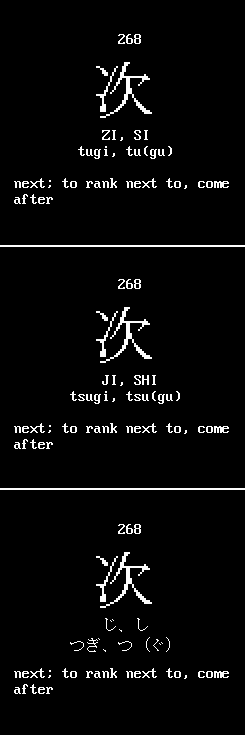
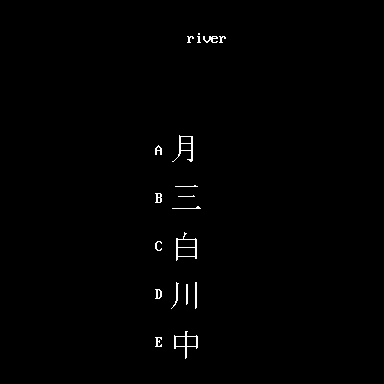
First up is a project I started a couple of weeks ago to keep the old Japanese reading skill sharp (or, you know, sharpen it for the first time). As of right now, there are two modes, one is a review which provides a kanji, its reading(s) and a definition of sorts (all according to the Tuttle Kanji Cards). The second mode is a quiz, which right now just shows a definition and gives five options of which one is the correct answer. Please note that the screenshots in the links are cropped to eliminate the considerable black space that makes up most of the screen, and the "review" shot is actually three screens on top of each other to show the two different styles of romanization for readings, and that there is the option to have the readings displayed in Japanese.

You can try the review mode of this program by downloading this

The other thing I was working on, but not so much lately, is Lisa Green Teaches Texting.


This thing is designed to satisfy mankind's need to practice texting? If you're using DosBox to run this one, make sure your CPU cycles are set to MAX, or else this thing will take forever to load. Also, there are a couple of things that don't quite work right: the text input screen doesn't word wrap to match the prompt, the cursor acts a little funny, and there was at one time a results screen that would rate and comment on your performance, but the formula pretty much praised everyone, so the results screen just gives a few stats.

You can download the mostly functional version of this here

Enjoy!

Friday, April 11, 2008

Translation Notes and Foreign Words Please

Charles Shrio Inouye was on campus yesterday to talk about translating Japanese, and he was interesting, but it was the conversation that followed during the Q&A portion that I've continued to think about.

A question was raised regarding how to know when to use a Japanese word in an English translation and when it's better to give an English equivalent or brief explanation. A German translator in the audience gave the example of schadenfreude, which is, of course the feeling of pleasure we feel at someone else's pain. Some translators will just use the German word schadenfreude, and some translators will give only the explanatory phrase. Still others will do what I just did, which is to use the word once, follow it with a gloss, and then continue to use it with the understanding that after explaining it, the reader will surely be able to recall the meaning of this new word: schadenfreude.

What surprised me was that the Japanese translator and one of his colleagues both rejected the idea of using the original word alone or along with the gloss, opting instead to find an English explanation. Their reasoning was that 1) glosses, footnotes, and other such breaks interrupt the flow of reading and 2) the use of foreign words tends to make the text exotic in ways that it shouldn't be. In other words, they think that when people read an English translation, they want to have an experience similar to that enjoyed by people who can read the original: one free of notes and new vocabulary.

I don't see how keeping translation notes out of a translation could possibly be better than including them. If all you have is a completely English translation, then you're relying on the translator's ability to transform the meaning of a sentence in one language into an equivalent sentence in your own language. What if the translator doesn't understand the original sentence perfectly? What if the original is open to interpretation? What if the original makes allusions that would be clear to native readers, but are unknown to foreign readers? Without notes you lose out on the possibility of seeing some of the original author's intention because he's been overtaken by the translator.

The refusal to use foreign words is equally baffling. How can you say that using the word genkan (the entrance to a Japanese-style home with a step in front of which shoes are left behind) makes a text exotic in ways that having a main character named Takeshi does not? Call the man Tim if you want to complete the illusion of creating an English version that is in all ways similar in reception to the original. And move him out of Tokyo and into Toledo while you're at it.

Using foreign words in texts is one of the ways in which those words enter the vocabulary of other countries. A pet peeve of mine is that movies and anime tend to translate itadakimasu when spoken before a meal. It's usually rendered as some kind of silly prayer or "let's eat!", but it always comes across as unnatural, because it's a single word used to begin a meal and should be spoken by everyone, and outside of "GRACE!" which is irreverent and therefore not practical for all cases, English doesn't have an equivalent and it's awkward to try to find one. However, if translators would just trust their audiences with the word itadakimasu on its own, I don't see why it wouldn't become as commonplace and understandable as the similar-in-function bon appetite that we've borrowed successfully from the French.

Just some thoughts.

Monday, March 17, 2008

"Grind" is Nonsense

Online communities tend to degenerate into effete self-congratulatory circle jerks about three minutes after conception. Really, all communities tend to do this shortly after conception; it's sort of what a community is. And while I would give the reward for biggest, most effete, self-congratulatory circle-jerk to the Penny-Arcade forums I think that the cesspool of jackassery one finds in Kotaku comment threads would come in a very close second.

In this thread about the evolution of World of Warcraft a brief conversation is maintained about grinding and whether or not World of Warcraft is a grind:

"Wow isn't a grind unless your rare/gold farming. You see, a Grind is a game like L2 or EQOA where you log on, form a group, pull the same camp for 4 hours to gain 1/10th a level, then log off, repeat each day without change. Wow doesn't play like that." - mrantimatter

"It does, however, play like 'kill guy A 50 times to get strong enough to kill guy B' etc. It's just that as you progress, it gets more complicated, because you have to either kill guy A more times (a lot more), or juggle your different buffs, debuffs, or whatnot. So, the same basic premise of 'kill the guy' just takes longer, and more key strokes. Combine that with infinity, and...well, it is all one big grind, really. Repetitive, tedious, and frustrating at times." - diablodevil2

In my attempt to discern who is correct, mrantimatter or diablodevil2, I consulted the wikipedia entry for grinding and discovered that 1) there is a wikipedia entry for "grinding" and 2) "grinding" is a nonsense term.

Here is the definition of "grinding" provided by wikipedia:
"Grinding is a term used in computer gaming to describe the process of engaging in repetitive and/or non-entertaining gameplay in order to gain access to other features within the game...To Grind means to do one task the most efficient way possible in a repetitious manner."

The problem is that this definition does not mean anything; it is a faux definition for a vapid term. All games are grinds; gaming itself is a grind. Tetris is a grind. Chess is a grind. God of War is a grind. Hell, life is a grind. Working, writing papers, bathing, eating, these are all activities to which the label "grinding" could be applied.

At the most basic level all video games involve a repetitive user input of data for the purpose of achieving some goal; all human activities can be explained and minimized down to a level of repetition towards some end. Whether or not we focus upon the repetition is a question of whether or not we're enjoying ourselves; whether or not we're having fun.

That is why the term "grinding" is nonsense. Grinding, repetition towards some end, is not unique to any given thing; World of Warcraft is really no more of a grind than Tetris or monogamous sex. When one employs the term "grind" as a form of criticism this does not indicate that the thing is uniquely repetitive but rather that the thing is less enjoyably repetitive for that particular individual.

And "enjoyable" is subjective.

Tuesday, February 26, 2008

Crap, Shit, and Poop

George Carlin's "Seven Words You Can't Say on Television" provides a delightful analysis of our idiotic segregation of language and the notion of a "bad word". The heart of the rant, I think, is the following:

"Yeah, there are 400,000 words in the English language, and there are seven of them that you can't say on television. What a ratio that is. 399,993 to seven. They must really be bad. They'd have to be outrageous, to be separated from a group that large."

While I have some friends (or at this point they may just be "people I knew in college who no longer talk to me") who do not use certain words I've never heard a reasonable explanation for why some words are socially acceptable, good and proper words for use in daily conversation while others are dreadful abominations of language. I understand that I cannot say "fuck" at work, but I've never been given a sensible reason for why this is. It is just one of those aspects of society that our mommies and daddies taught us. As I am still confused, though, I shall present my question in the following condensed manner:

What the fuck is the difference between crap, shit, and poop?

Take, for example, the exclamations, "Oh crap!", "Oh shit!", and "Oh poop!". What are the differences between these three exclamations?

Oh poop!: This seems to be a more juvenile and childish exclamation.
Oh crap!: This seems to be a socially acceptable exclamation that one could say inside of, say, a church.
Oh shit!: This seems to be an exclamation that which is not socially acceptable.

Fundamentally, though, they are all the same. They are variations upon the exclamation "Oh no!"; they are exclamations uttered when something bad happens. But what is the difference between the three? Crap, Shit, and Poop all reference the same thing: excrement. So what is the difference between these words? What makes "crap" socially acceptable while "shit" is not?

For that matter what is the difference between "fucked" and "screwed", "darn" and "damn", "gosh" and "god", "hell" and "heck"?

Each of these expressions fulfill the same utility within our speech. "I'm fucked" and "I'm screwed" mean the same thing, convey the same notion. So why is "screwed" acceptable while "fucked" is not? Why would someone say "heck" rather than "hell"?

Obviously our problem is not with the communication of any given situation or idea. If an individual is in a situation in which they are screwed/fucked we have no problem with them communicating their predicament. The concern we have is for how they communicate. If a person were to say "What the heck?" there would be no problem yet "What the hell?" is somehow problematic. But, again, what is the difference?

The answer is not "the words themselves". There is not some link between the noise we make when we say "fuck", the letters used to compose the word "fuck", and the dreadful nature of the word "fuck". The words shit, crap, and poop are not somehow dynamically different so denoting the degree to which either is appropriate in any given situation; one could not objectively analyze any of these words outside of the social context in which they exist and somehow discover which is socially acceptable and which is not.

So what the god-damned fucking hell is the difference, then?

Wittgenstein described language as a language-game. Wittgenstein dismissed the idea of words as boats, of a fashion, which are used to transport ideas from one's mind to the mind of another and rather discussed language in terms of the language-game, the social construct.

This, I think, is the answer to the question of difference. There really is no difference between shit, crap, and poop unto the words themselves but rather the difference is found in the arbitrary rules constructed by those who use the language. "Shit" was decided to be less acceptable than "crap" which is more mature than "poop". "Heck" was created to fill in for "hell". "Screwed" takes the place of "fuck". "Gosh darn" serves the purpose of "God damn" without making anyone uncomfortable.

And when you think about it? When you realize that the only difference between crap, shit, and poop is that arbitrary designation? You relize that it's all incredibly god damned re-fucking-tarded.

Oops. I ought to have said, "gosh darned re-frickin-tarded" so as not to insult the shitheads.

Err..."crapheads".

There we go.

Tuesday, January 29, 2008

The you in gaming.

I've been thinking about the manner in which we talk about games.

If I were to describe Mario Galaxy to someone I would say, "You push buttons, move the Wiimote around, and are bored after six minutes." Someone else would perhaps bypass the mechanical description of pushing buttons and moving the wiimote to instead concentrate on what the character does. Another person might use "you" to describe some hybrid of Mario/player so attempting to describe the situation to be such that the player was in some way a part of the game; rather than saying "mario becomes a bee" such a person would say "you become a bee".

Guitar Hero is another great example. What does "you" do in guitar hero? Press buttons? Rock out with their cock out? Employ their sense of rhythm? What is the "you" in Guitar Hero? Is there a way to determine this objectively or is it subjective?

Zero Punctuation reviews tend to use "you" fluidly. "You" can be the player, the character, or the hybrid of the character/player. In the same review "you must escort NPC X" and "you get bored and play with a yo-yo". What does it mean to use "you" in this fluid sense? What does it say about the degree to which one is engaged in the game?

Yesterday a coworker asked, "What do you do in WoW?" My reply was that you run instances to get good gear so that you can run raids to get better gear so that you can run more difficult raids to get even better gear. I described the game in terms of the pursuit of better gear via a knowledge of mob loot tables. "You" was not engaged in an epic battle for the freedom of Azeroth. Rather, "you" was the individual playing the game attempting to find better loot for the character "you" played.

Does it behoove the conversation about gaming to use "you" in this fluid sense? Is there a way to not use "you" in this manner? How would one describe a game if "you" were removed? Would that lead to an emphasis upon the separation between character and player? Does the type of game influence how one uses "you"; is the Tetris "you" different from the RPG "you" or does that depend upon the attitude one has towards the game?

What is the "you" in gaming?

Tuesday, September 18, 2007

Typhoons are not sentient.

"A powerful typhoon targeted China’s booming eastern province...".

Targeted:
1) To make a target of.
2) To aim at or for.
3) To establish as a target or goal.

Typhoons do not "target". Typhoons are not sentient. Typhoons do not posess the rational facilities necessary to "target" something. Typhoons are not active agents; typhoons do not perform actions. Typhoons are not "beings". Typhoons are not things. Typhoons do not decide. Nor do typhoons choose or plot or plan.

Typhoons are a state of being for weather, a non-thing. The Typhoon is not "targeting" China's booming eastern province. It merely exists in a state such that it will pass over China's booming eastern province.